
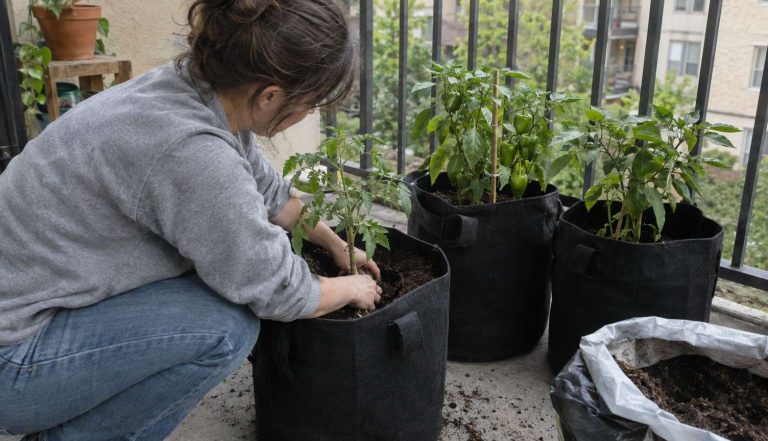
One standard tomato needs a container of at least 5 gallons, says University of Maryland Extension, the state university’s public advice service.
For tomatoes, peppers or herbs on a patio or balcony, start with the VIVOSUN 5 Gallon Grow Bags, 5-Pack.
A note on the links: a few of them are Amazon affiliate links. Anything bought through one sends a small commission this way, and costs you nothing extra.
The four bags, by what you are growing:
| Your plants and space | A calm choice |
|---|---|
| Tomatoes, peppers or herbs, and you want a set to start with | VIVOSUN 5 Gallon Grow Bags, 5-Pack |
| One 5 gallon bag rather than a pack | Smart Pots 5 Gallon Soft-Sided Container |
| Larger tomato varieties, peppers or eggplants | Gardzen 10 Gallon Grow Bags, 10-Pack |
| Potatoes in one large bag | Smart Pots 20 Gallon Soft-Sided Container |
VIVOSUN 5 Gallon Grow Bags, 5-Pack
Tomatoes, peppers or herbs on a patio, and you want a set to start with
 VIVOSUN 5 Gallon Grow Bags, 5-Pack
Nonwoven fabric with double-stitched handles
Five bags, 5 gallons each
See the price and reviews on Amazon
VIVOSUN 5 Gallon Grow Bags, 5-Pack
Nonwoven fabric with double-stitched handles
Five bags, 5 gallons each
See the price and reviews on Amazon
VIVOSUN lists thickened nonwoven fabric (cloth made without weaving) with reinforced handle straps. It says the fabric keeps roots aerated and drains excess water, which it says prevents over-watering and moldy soil.
Five gallons is Maryland Extension’s minimum for a standard tomato or a pepper, and for large herbs such as rosemary or sage. Each bag meets that minimum for a single plant.
Smart Pots 5 Gallon Soft-Sided Container
You want one 5 gallon bag rather than a pack
 Smart Pots 5 Gallon Soft-Sided Container
Soft-sided fabric that holds its shape
12 inch diameter by 9.5 inch height
See the price and reviews on Amazon
Smart Pots 5 Gallon Soft-Sided Container
Soft-sided fabric that holds its shape
12 inch diameter by 9.5 inch height
See the price and reviews on Amazon
Smart Pots lists a soft-sided fabric container with the rigidity to hold its shape. It also says the container allows excess heat to escape.
The listing gives 12 inches across and 9.5 inches high, so the bag is wider than it is tall.
Maryland Extension says a 5 gallon container wider than tall is less top-heavy and more stable in a breeze than a taller one of the same volume.
Smart Pots says the aeration builds a vigorous plant with more flowers and fruits, and that the container was developed for commercial tree growers.
Gardzen 10 Gallon Grow Bags, 10-Pack
Larger tomato varieties, peppers or eggplants, with ten bags to fill
 Gardzen 10 Gallon Grow Bags, 10-Pack
Ten bags, 10 gallons each
16 inch diameter by 12 inch height
See the price and reviews on Amazon
Gardzen 10 Gallon Grow Bags, 10-Pack
Ten bags, 10 gallons each
16 inch diameter by 12 inch height
See the price and reviews on Amazon
Gardzen lists 16 inches across and 12 inches high, and names larger tomato varieties, peppers and eggplants as the plants it suits. The handles carry cross-stitched reinforcement, it says, for moving a fully loaded bag.
Ten gallons is twice Maryland Extension’s 5 gallon minimum for a standard tomato, a pepper or an eggplant.
A Maryland photo caption shows indeterminate (vining) tomatoes in 25 gallon pots. It adds that they can grow in smaller ones, but grow larger and produce more fruit as container size increases.
Smart Pots 20 Gallon Soft-Sided Container
You want to grow potatoes in one bag larger than 10 gallons
 Smart Pots 20 Gallon Soft-Sided Container
20 gallon capacity
20 inch diameter by 15.5 inch height
See the price and reviews on Amazon
Smart Pots 20 Gallon Soft-Sided Container
20 gallon capacity
20 inch diameter by 15.5 inch height
See the price and reviews on Amazon
Smart Pots lists 20 gallons, 20 inches across and 15.5 inches high, with the same fabric and heat-release line as its 5 gallon bag.
University of New Hampshire Extension, the university’s public outreach arm, gives 10 to 15 gallons as the ideal capacity for a potato container.
This bag holds more than that range.
At UNH’s five gallons of soil for each plant, 20 gallons works out to four plants. UNH describes the ideal container as about 2 to 3 feet tall, and this bag is 15.5 inches tall.
Maryland Extension notes that a 20 inch container filled with moist potting mix and plants can weigh 100 pounds.
Container size by crop
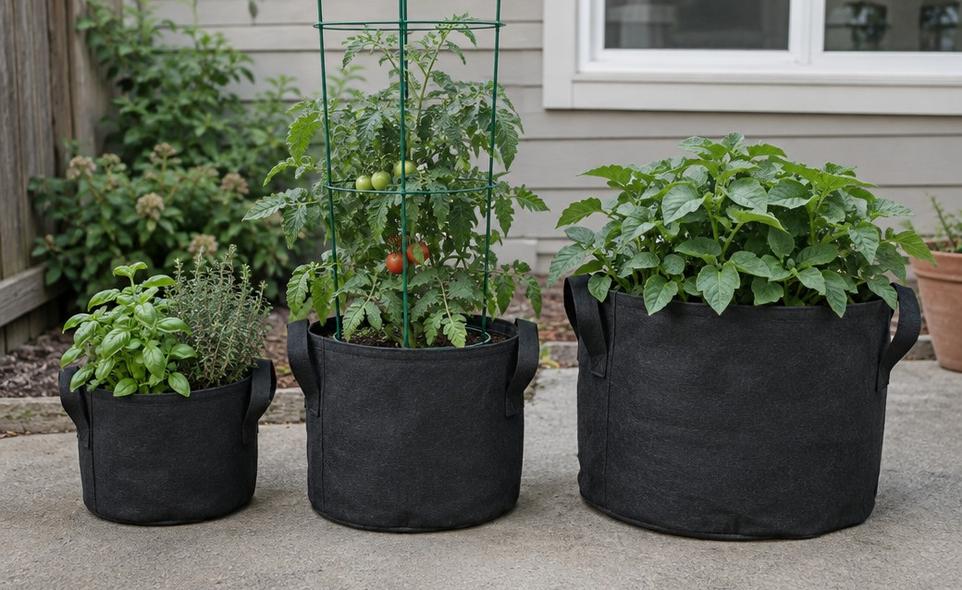
For tomatoes, the minimum figures run from 2 to 5 gallons per plant. Colorado State University Extension, which publishes its garden notes through its Master Gardener program, gives that range depending on variety.
Maryland Extension gives 5 gallons for a standard tomato and 2 gallons for a cherry tomato.
| Crop | Container size | Who says so |
|---|---|---|
| Tomato, standard | 5 gallons minimum | Maryland Extension |
| Tomato, cherry | 2 gallons minimum | Maryland Extension |
| Tomato | 2 to 5 gallons per plant minimum, depending on variety | Colorado State Extension |
| Pepper | 5 gallons minimum | Maryland Extension |
| Pepper | 2 to 5 gallons per plant minimum | Colorado State Extension |
| Eggplant | 5 gallons minimum | Maryland Extension |
| Eggplant | 4 to 5 gallons per plant minimum | Colorado State Extension |
| Potato | Ideal: 10 to 15 gallon capacity, about 2 to 3 feet tall; 5 gallons of soil for each plant | UNH Extension |
| Potato | Three plants grew in one 5 gallon fabric bag, in Maryland’s photographs | Maryland Extension |
| Large herbs, such as rosemary, sage and parsley | 5 gallons or larger | Maryland Extension |
| Small herbs, such as basil, thyme and mint | 2 to 5 gallons | Maryland Extension |
Maryland adds that bush, dwarf and compact varieties can grow in smaller containers than their full-size counterparts. It also lists potatoes among the more challenging vegetables for containers.
Why fabric
Maryland Extension says roots that reach open air at the bag’s edge stop growing in length and branch into a denser root system.
It calls this air pruning.
In a non-porous pot, it says, a root meets a solid wall and keeps growing as a single root.
Drainage matters in any container, and VIVOSUN and Gardzen both list drainage of excess water. Maryland also describes fabric bags as reusable, lightweight and portable, in many sizes.
Hot weather is the other thing to plan around. Maryland says hot temperatures dry containers out quickly and small containers dry out faster than large ones.
Until you know how fast a bag dries, Maryland says to check it daily, especially in summer.
University of Illinois Extension, the outreach arm of the state university’s agriculture college, adds that watering has to increase as plants get bigger. Maryland also shows straw mulch on a large fabric grow bag to reduce evaporation.
How long they last
Gardzen lists its bags as designed for multi-season use, and as washable and foldable for easy storage. VIVOSUN lists double-stitched handles meant for carrying full bags.
University of Illinois Extension notes that fabric grow bags fold flat to store.
Maryland Extension says to empty the potting mix after harvest and store it, then mix it half and half with fresh mix next season. It says not to save the mix if root diseases were a problem.
When a bucket will do
A 5 gallon food-grade bucket with holes drilled in the bottom grows a plant too, according to Maryland Extension.
It shows broccoli growing in one, and lists food-grade storage containers, wooden crates, half whiskey barrels and non-PVC kiddie pools as other suitable containers.
For potatoes, UNH says any opaque container with drainage holes will do, including barrels, garbage bins and plastic storage tubs.
A bucket that once held paint or cleaning agents is no longer food-safe, Maryland says. A solid bucket also lacks the air pruning Maryland describes for fabric.
Matching a bag to your crop
The 5 gallon bags meet Maryland’s minimum for a standard tomato, a pepper and an eggplant. Choose the VIVOSUN set for several bags, or the Smart Pots 5 gallon bag for one.
Choose the Gardzen bags for the larger sizes, and the Smart Pots 20 gallon bag for potatoes.
Potting mix, a watering can and the rest of a first setup are covered in what you need to start container gardening.
Potatoes are a winter crop in Florida’s heat. For crops that keep producing when summer turns hot, there is a list of vegetables that handle summer heat.
A 2-cubic-foot bag of potting mix fills three 5-gallon bags, which is enough for three of the VIVOSUN bags.