
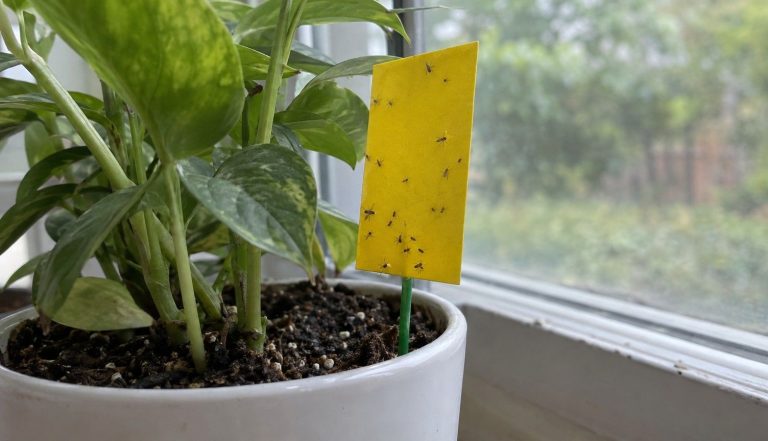
Those tiny dark flies are fungus gnats. They are not a fruit bowl problem.
They live in the soil of your houseplants, and the flies you see drifting around the pot are the adults.
They do not harm you.
They are a sign that the potting mix stays wet, and that is also how you get rid of them.
Fungus gnats or fruit flies?
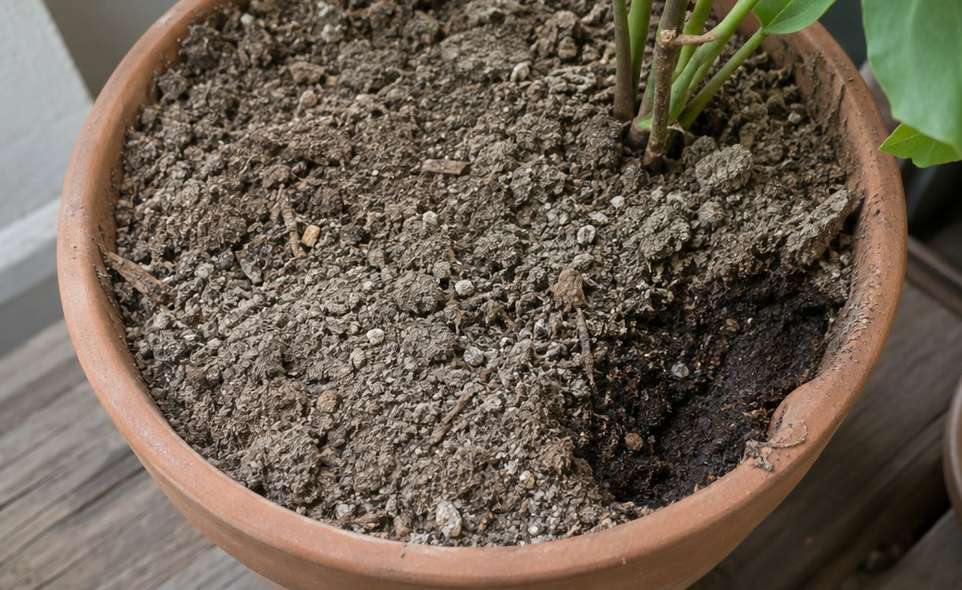
Fungus gnats are small, dark and delicate-looking. The University of California’s Statewide Integrated Pest Management Program is the state university’s free pest advice service.
It puts them at about 1/16 to 1/8 inch long, with slender legs.
University of Maryland Extension, that state university’s free public gardening advice service, adds that they are commonly seen around lamps and windows.
Where the flies gather is a good first clue.
- Hovering over one pot or resting on its soil: fungus gnats.
- Circling ripe fruit or the trash: a different pest, and the steps below will not reach it.
Colorado State University Extension, another free state university advice service, is reassuring on one point.
The adults do not bite.
They are a nuisance, not a danger.
Why they come
Colorado State says the larvae (the young, worm-like stage) feed on algae, fungi and plant roots in the growing medium. They are usually in the top 2 to 3 inches.
That is why the problem sits in the pot. A damp surface feeds the fungi and algae the larvae live on.
Maryland’s guide gives the plain consequence: when the soil dries, the larvae die.
Wet potting mix is what lets them breed. Drying the mix is the main way to stop them.
Step 1: Let the top of the soil dry
This is the first fix, and it costs nothing.
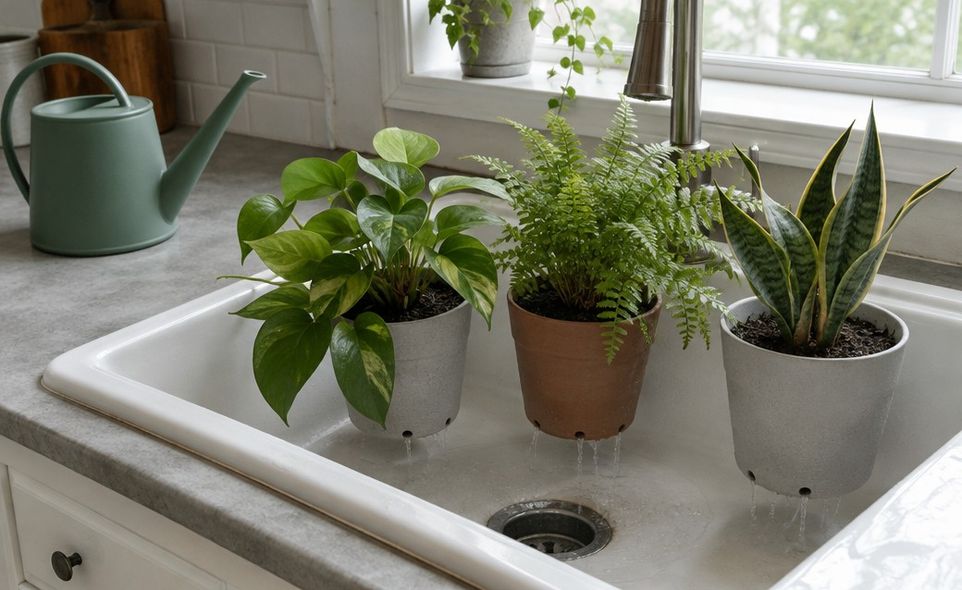
Colorado State recommends letting the growing medium dry between waterings, particularly the top 1 to 2 inches.
Push a finger into the mix. If it feels damp at that depth, wait. Water when it feels dry.
If you are not sure whether your plant is getting too much water, the signs are laid out in how to tell overwatering from underwatering.
Empty any saucer that holds standing water too.
Water sitting under the pot keeps the mix damp from below.
Step 2: Put out yellow sticky traps
Drying the soil deals with the larvae. Yellow sticky traps catch the adults that are already flying.
Colorado State says the adults are attracted to yellow and get captured on yellow sticky cards.
Place them underneath the plant canopy or on the edge of the container.
The University of California suggests cutting yellow sticky traps into smaller squares and attaching them to wooden skewers or sticks. Stand them in the pots.
A trap also works as a counter. Fewer flies on the trap each week is a good sign the plan is working.
Step 3: Treat the soil with Bti
If the flies keep coming several weeks after you changed your watering, there is one more option Extension services name. It is a soil drench containing Bti, short for Bacillus thuringiensis israelensis.
The University of California describes Bti as a naturally occurring bacterium that is toxic only to fly larvae. Colorado State says it can kill larvae when applied as a drench to the growing medium.
Two cautions from those pages.
Repeat applications are commonly needed for long-term control.
The University of California says several Bti products are readily available in retail nurseries and garden centers. Maryland’s guide says to look in garden centers or search online.
Follow the label on whatever product you buy. Use it exactly as the label directs.
Why it takes more than a day
You may do everything right and still see flies for a while. That is normal.
The University of California says a generation of fungus gnats can be produced in about 17 days, depending on temperature.
Colorado State puts the full life cycle at three to four weeks at typical room temperatures of 65 to 75 degrees Fahrenheit.
Some of the larvae and pupae already in the soil can still become adults after you change your watering.
A few flies in the first week or two does not mean the fix has failed.
Not a gnat problem after all?
A pot that stays wet may also be one where the plant is struggling.
If the plant itself looks unwell, the common reasons houseplants die are worth running through.
If you keep fighting wet soil, a plant that tolerates a missed watering makes this easier. Some forgiving houseplants for people with no outdoor space suit that kind of care.
The two-week check
Keep the sticky trap in the pot and look at it after two weeks of drier soil. This is an early read, not the final verdict.
Count what is stuck to it and compare it with the first week.
A trap with noticeably fewer new flies is a good sign that fewer adults are emerging.
If the trap is still filling at the same rate, check the top inch of soil first.
Still damp means it is still a breeding ground.
If it is dry and the trap is still filling after three to four weeks, a Bti drench is the next step, repeated as the label directs.