
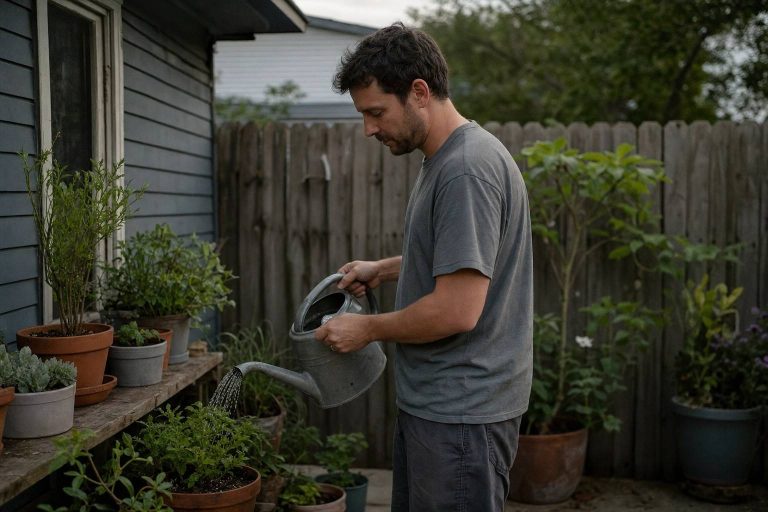
The commute used to do it. A walk, a drive, a train ride with nothing to look at. Time between the desk and the door.
Most people have lost that gap. Work ends and home begins, often in the same chair, and the brain stays switched on hours longer than it should.
A few minutes in the garden can fill that gap. Not because it is clever, but because it forces a different kind of attention.
Why the gap matters
Your brain shifts poorly between modes. Work thinking is narrow, forward-looking, alert to problems. It does not stop because you closed the laptop.
Rest needs a gear change, and gear changes need something to push against. A physical task in a different space, with your hands busy and the screen gone, gives the brain something to actually shift into.
The garden works here because it is slow, grounded, and completely unlike the thing you just left.
Keep the phone inside
Leave it on the counter. Fifteen minutes of being genuinely unreachable is not a sacrifice.
If the phone comes outside, work comes outside. A message, a notification, a quick check: you are back at the desk in your head.
For most people, an unplugged fifteen minutes outside is the first quiet moment of the whole day.
A simple routine you can actually repeat
The routine should be short enough that you do it every day, not just when you feel like it. Think of it as a walk through your plants with no agenda.
- Take a slow circuit of your pots or bed. Notice what has changed since yesterday.
- Water anything that needs it. Do it slowly, one pot at a time.
- Pull a dead flower or a yellowing leaf. Deadheading takes two minutes and leaves everything looking tidier.
- Pick one thing you notice. A new bud, a leaf that has finally opened, a shoot you missed last time.
That is enough. You do not need to achieve anything.
The point is the attention, not the output.
Why noticing one thing helps
It sounds almost too small. But making yourself find one detail pulls your attention fully outside your own head and into something alive and specific.
Work brain makes lists and solves problems. Garden brain notices a bud. These two things cannot quite happen at the same time.
Pooling 22 studies, a 2017 Preventive Medicine Reports review tied gardening to reduced anxiety and greater life satisfaction. The mechanism is not magic. It is presence, at a pace you cannot rush.
What this is not
It is not a garden session. You are not trying to get things done.
The beds can wait. The weeding can happen at the weekend. This is the ten-to-twenty-minute version: a deliberate gear-shift that happens every evening, not an ambitious project you tackle when the mood strikes.
Small and consistent beats large and occasional every time.
Two pieces go deeper. One covers how gardening genuinely lowers stress when you keep it small and forgiving. The other covers what the research actually found on gardening and stress levels.
What to grow if this is new to you
You do not need much for this kind of routine. A few pots by the door or on a step is enough.
Herbs work well. Mint, basil, and rosemary are forgiving, grow fast enough to change visibly between visits, and smell good when you brush past them. A pot of marigolds gives you color and a steady supply of deadheading.
A small raised tray of lettuce gives you something to check on.
Pick things that grow fast enough to reward daily attention. Slow growers are satisfying over months, but they do not help with a wind-down routine that runs on small daily changes.
A small raised tray of lettuce gives you something to check on.
If you want a starting point without overthinking it, compare beginner planter pots on Amazon and start with two or three.
A note on the links: a few of them are Amazon affiliate links. Anything bought through one sends a small commission this way, and costs you nothing extra.
One honest note. Spending time in the garden may support how you feel after a long day, but a garden routine is not a treatment for stress, anxiety, or any health condition.
If things feel like too much, please talk to your doctor or someone else qualified to help.