
When is it actually safe to put your tomatoes outside?
That is the real question behind “last frost date.” Most gardeners treat it like a green light, a day the weather has quietly agreed to behave.
A last frost date is an average, not a promise. It comes from decades of temperature readings at a nearby weather station. It is not a commitment the coming season has made to you.
Seen that way, the number gets easier to use, not harder.
What the date is actually built from
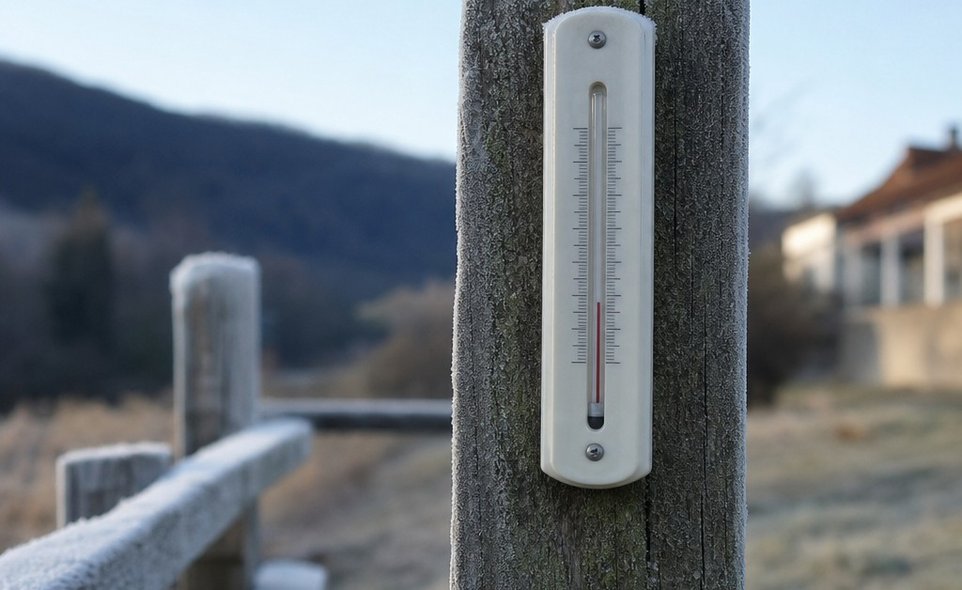
Your last frost date comes from the U.S. Climate Normals. The National Centers for Environmental Information at NOAA, the US federal ocean and weather agency, keeps this record for thousands of stations across the country.
NOAA describes the Normals as working “both as a ruler to compare today’s weather and tomorrow’s forecast, and as a predictor of conditions.”
That is a modest claim. A ruler measures. It does not promise.
The Normals cover roughly 15,000 stations nationwide. Frost and freeze dates are one of several variables tracked this way, alongside things like snowfall and growing degree days.
They come in two versions:
- Conventional 30-year normals, the standard most gardeners see
- Shorter 15-year normals, for a more recent slice of the record
The current 30-year set draws on readings from 1991 to 2020. It is the latest in a series NOAA has produced roughly every decade since the 1950s, released in May 2021.
What the average actually promises you
Averaging thirty years of data gives you something genuinely useful. It tells you what is typical.
It does not give you a schedule.
Across those thirty years, some springs ran later than the average and some ran earlier. The average sits in the middle of that spread rather than at the safe end of it.
The date narrows the guess. It does not remove the guess. Your particular spring is going to land somewhere in that spread, and there is no way to know exactly where in advance.
Why the first frost does more damage than the last
Gardeners talk about the last spring frost far more than the first one in fall. In terms of real damage, that is a little backward.
Plants do not go into winter unprepared. Through late summer and early fall, cooler temperatures and shorter days trigger cold acclimation, a gradual toughening-up process.
That process needs time to run on schedule. Cold acclimation has to happen at the right pace, according to Georgia’s Cooperative Extension, the state university’s free growing-advice service. Too early, and the growing season gets cut short.
Too late, and an early frost injures or kills plants that never had the chance to harden off.
Plants that went into the ground only recently and haven’t had time to establish face the greatest risk. They have not had a season in the ground to adjust to anything yet.
That is worth keeping in mind alongside how you actually protect plants once frost is forecast. An early, unexpected frost is often the one that catches a garden off guard, not the familiar spring one everyone plans around.
Using the date without being ruled by it
So what do you actually do with a number like this?
Treat the weeks well before and after your average date as fairly settled, cold before it, warmer and safer after it. Treat the final two or three weeks on either side as a genuine judgement call.
That is where the real decision-making happens, not on the date itself.
- Check the actual short-range forecast, not the calendar
- Watch for a clear, calm night, the kind that tends to run coldest
- Keep something to cover tender plants within easy reach
- Hold off on your most cold-sensitive seedlings if a cold snap is forecast, average date or not
None of this needs special equipment. It just means checking the forecast instead of trusting the date on its own.
Frost risk needs to have genuinely passed for the season first. Only then can heat-loving summer vegetables safely go in, rather than the moment the calendar says spring arrived.
Your first fall frost date is also a handy reminder to start checking soil temperature before planting tulip bulbs.
Where to look up your own
Frost dates are searchable through NOAA’s Climate Normals by station, zip code, city, county, or state. That lets you find the record closest to your actual garden, not a general figure for your whole region.
Your zone number, covered separately in what your hardiness zone actually tells you, measures something different. It tells you how cold your winters typically get.
Frost timing is its own figure, calculated on its own, and this is where it lives.
For anything more local than the national data offers, your state’s Cooperative Extension office is worth a look. Extension offices publish frost and planting guidance tuned to their own state, detail a national average cannot capture on its own.
Even a well-calculated average is still an average. It tells you what is typical for your spot, built from thirty years of real readings. What it cannot tell you is what this particular spring is going to do.
That part was never something a date on a calendar could answer.